



Germany’s Working Holiday Visa - The Complete Guide
by Jessie Chambers 2 years ago
9 MIN READ
This article was reviewed and updated for accuracy on September 29th 2026
Picture the setup. A flat in Neukölln with those absurdly tall ceilings. A morning walk to a cafe where nobody minds you occupying a table for four hours. Client calls done by three, then the rest of the afternoon is yours in a city that runs on cheap transport, good bread and an almost aggressive amount of green space.
Now the thing that stops most people at the first search result: Germany does not have a digital nomad visa. It never has.
What it has instead is a residence permit for self-employed people that has been quietly doing the same job for years, and doing it better than most of the shiny new nomad visas, because it leads somewhere. This isn't a twelve-month novelty that expires and waves you off. It's a route with renewals at the end of it.
The paperwork is more German than you're ready for. The payoff is that you're a resident, not a visitor. Ready for pretzel and beers on the reg? Buckle up!

The Honest Position
Germany has no visa aimed at remote workers employed by a company back home. If that's your exact situation, employed full-time by a foreign employer with no self-employed status, this route is genuinely difficult and you should know that before you read on.
Where Germany works brilliantly is if you're self-employed. Freelancers, consultants, designers, developers, writers, translators and similar independent professionals apply for a residence permit under Section 21 of the Residence Act, and it's one of the more generous arrangements in Europe once you're through it.
Germany for Remote Workers at a Glance
- The visa that doesn't exist: there is no German digital nomad visa
- What you use instead: a residence permit for self-employment under Section 21 of the Residence Act
- Two routes: Freiberufler for liberal professions, Selbständiger for commercial trades
- Duration: typically up to three years initially, with renewal possible
- Income requirement: no fixed statutory figure. You must show you can cover your own living costs
- Health insurance: mandatory, and it must be German-recognised cover rather than a travel policy
- Where you apply: the local Ausländerbehörde if you can enter visa-free, otherwise a German mission before you travel
- The catch: the tax office decides which route you're on, not you
The Freelance Route: Freiberufler
This is the one most remote workers want. It sits under Section 21(5) and covers the liberal professions: doctors, lawyers, engineers, architects, translators, journalists, artists, writers, and independent IT consultants and designers.
What you actually need to show:
- Professional qualification: evidence you're qualified to do what you say you do, whether a degree, vocational certificate or a documented professional record
- German health insurance: a proper policy recognised in Germany. Travel insurance does not count for a long stay, and applying without adequate cover is a fast route to refusal
- Secured livelihood: proof your work will cover your living costs. This is the requirement people misunderstand most, covered below
- A registered address in Germany: you need somewhere to live and you need to register it
- Evidence of work: client contracts, letters of intent or documented assignments showing your practice is real and ongoing
- Pension provision if you're over 45: applicants over 45 must show adequate retirement provision. This catches people out constantly and there's no way around it
On the income question. You'll see a figure of around €9,000 a year quoted widely online, including in older versions of this guide. It isn't a statutory threshold and treating it as the bar is how applications get refused. There is no single official number. What the Ausländerbehörde actually assesses is whether your projected income covers your rent, your health insurance premium and your living expenses, which means the real bar in Berlin or Munich is considerably higher than in a smaller city. Build your figures around your actual costs and show generous headroom.
On German clients. Section 21(5) does not legally require you to have German clients. Plenty of established freelancers in Berlin invoice almost entirely abroad. That said, one or two German or EU client relationships strengthen a first application meaningfully, because they demonstrate you're building something real rather than using the permit as a convenient base. Helpful, not mandatory, and the difference matters if all your work is international.
The Self-Employment Route: Selbständiger
If your work is a commercial trade rather than a liberal profession, meaning you sell products, run an agency or operate a shop or online business, you're on the Section 21(1) route instead, and the bar is higher.
Here you need to demonstrate an economic interest or regional need for your business, a positive forecast for it, and secured financing through either your own capital or a committed loan. In practice that means a full business plan, financing plan and supporting documentation rather than a portfolio and some contracts.
It's a genuinely different application. Don't prepare one and submit it for the other.
Which Route Are You On?
Here's the part almost nobody tells you: you don't get to decide. The Finanzamt, the German tax office, classifies your activity when you register, and the Ausländerbehörde follows that classification.
The English word "freelancer" and the German "Freiberufler" are not the same thing. A designer selling services is likely a liberal profession. The same designer selling templates through a shop is likely running a commercial trade. Software developers can land either side depending on how the work is structured.
Get an opinion on your classification before you build the application around a guess. It's the single most common reason these fall over. And no one wants to have to “circle back” on paperwork and admin.
How to Apply
Your nationality decides the shape of this entirely.
If you hold a passport from Australia, Canada, Israel, Japan, New Zealand, South Korea, the United Kingdom or the United States, you can enter Germany without a visa and apply for your residence permit from inside the country. This is a real privilege and it makes the whole thing considerably easier.
- Enter Germany. No advance visa needed
- Register your address within two weeks. The Anmeldung at your local registration office is the key that unlocks everything else, including banking and tax registration
- Sort health insurance. You need this in place before your appointment
- Register with the tax office and get your classification and tax number
- Apply at the Ausländerbehörde within 90 days of arrival. Appointments are booked online and in the bigger cities they are the genuine bottleneck. Start looking for a slot the week you land
- Attend, submit, wait. Decisions can be immediate or can take considerably longer depending on the city and the caseload
Everyone else applies for a national visa at a German mission before travelling. Book the appointment early, expect the fee to sit around €75 for the national visa, and assume the process takes months rather than weeks. Once you arrive you convert it to the residence permit at the Ausländerbehörde.
One thing worth knowing: the Chancenkarte, Germany's opportunity card, does not permit freelancing or self-employment. It's a job-seeking route, and it isn't a workaround for this.

The Reality Nobody Puts in the Brochure
Berlin's Ausländerbehörde appointment system is legendary in the worst way. People wait months for a slot. Build that into your timeline rather than assuming you'll be sorted in a fortnight.
Finding a flat is the other genuine hurdle. The German rental market runs on Schufa credit scores, proof of income and long queues at viewings, none of which you have on arrival. Most people start in a sublet, called a Zwischenmiete, and that's the normal path rather than a failure.
Health insurance is more expensive than newcomers expect, particularly for the self-employed, and it's a fixed monthly cost from day one. Factor it into your income projections before you submit them, not after.
And German bureaucracy is not hostile, it's just literal. Bring every document, bring copies, bring the ones you were told were optional. The system rewards preparation and punishes improvisation - and not in the fun way either!
If Remote Work Isn't Your Situation
If you're not self-employed and the freelance route doesn't fit, Germany runs youth mobility arrangements that let young travellers work there for up to a year. Age limits generally run to 30, with Canadians getting until 35, and the eligible countries and application routes vary, so confirm the current terms with your nearest German mission.
Global Work & Travel also runs two live trips in Germany if you'd rather arrive with the setup handled: Au Pair in Germany, which includes flights and runs six to twelve months for 18 to 26 year olds, and Tutor in Germany, a shorter one to three month option open up to 39.
Where to Actually Base Yourself
Berlin
Still the obvious answer, still correct. Neukölln and Kreuzberg are where the scene actually is, all Spätis and canal-side drinking and rents that are climbing but haven't caught the rest of Western Europe. Friedrichshain for nightlife proximity, Prenzlauer Berg if you've reached the stage of life where you want a quiet courtyard.
- Working: St. Oberholz on Rosenthaler Platz is the original laptop cafe and still packed for a reason, Betahaus in Kreuzberg is the co-working default, and half the cafes in Neukölln will let you sit all day without a word
- Nights: Berghain needs no introduction and no advice from us, Sisyphos out east is the one that feels like a festival that forgot to end, and about blank does the political, sweaty, garden-attached version
- Sundays: Tempelhofer Feld, a decommissioned airport turned public park where people cycle down the runways, and Markthalle Neun in Kreuzberg for the food
Berlin is not efficient, not polished, and not really representative of Germany at all. That's rather the point.
Leipzig
The one people move to when Berlin gets expensive, and increasingly the one they prefer. Plagwitz in the west is the engine: a former industrial quarter along the canals, now studios, galleries and bars, anchored by the Spinnerei, an enormous old cotton mill converted into one of Europe's better art complexes.
Karl-Heine-Straße is the spine of it, Karl-Liebknecht-Straße in the south is where students drink, and the Distillery has been carrying eastern Germany's techno scene since long before it was fashionable. Rents undercut Berlin noticeably and the trains to everywhere are quick.
Munich
Expensive, orderly, and much more fun than its reputation suggests. Glockenbachviertel is the creative and nightlife quarter, and the Isar river running through the city is the thing that actually sells it. In summer the banks fill with people swimming, barbecuing and doing very little.
Two Munich details you'll never quite believe: people surf a standing wave on the Eisbach in the Englischer Garten year-round, in the middle of a city park, and the beer gardens legally let you bring your own food. Bring the food.
Cologne
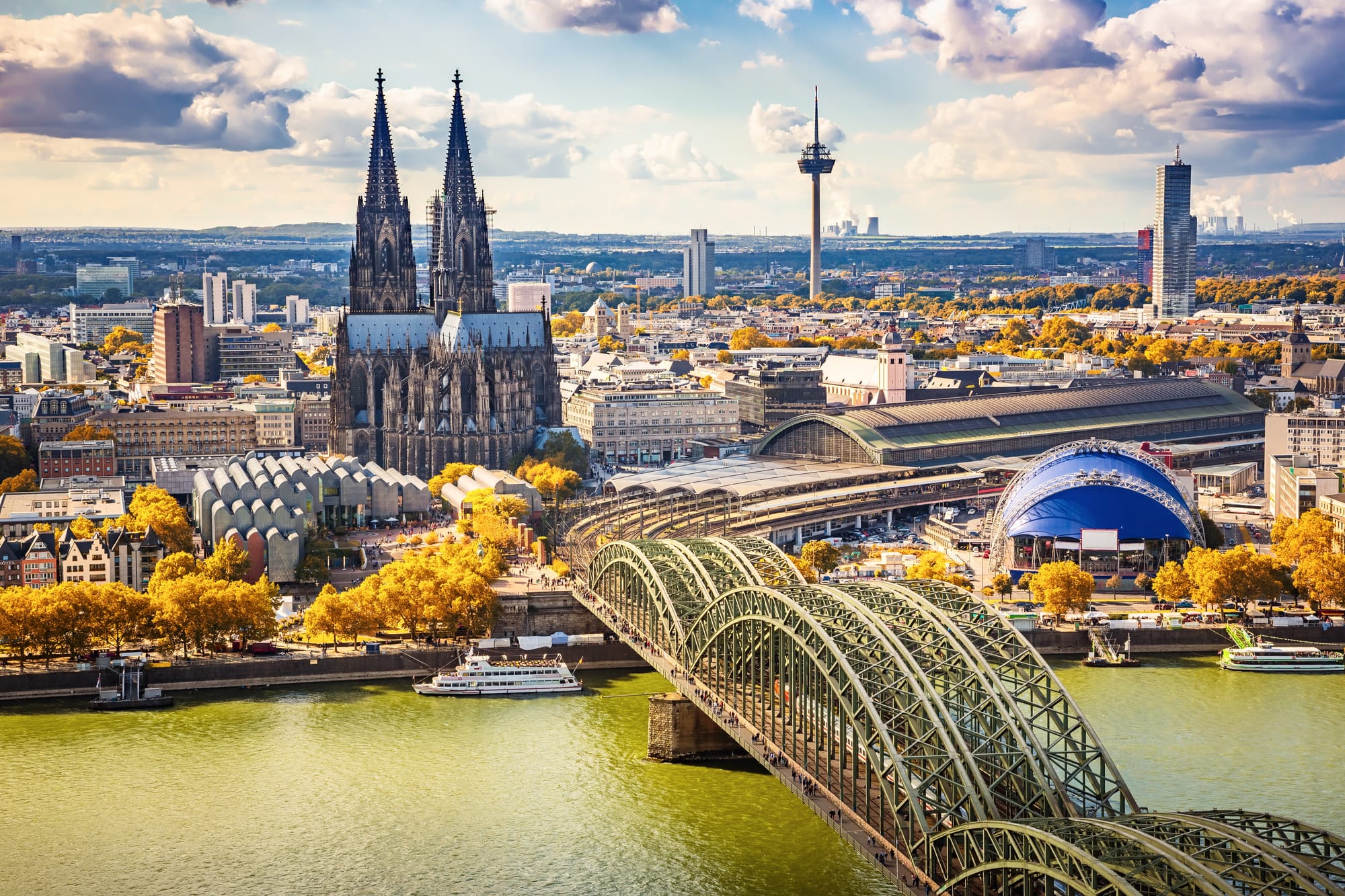
The friendliest big city in Germany and it isn't close. Belgisches Viertel for design shops and bars, Ehrenfeld for the grittier, cheaper, more interesting version.
Kölsch, the local beer, comes in small glasses that get replaced without you asking until you put your coaster on top, which is a system that will get you into more trouble than you expect. Bootshaus handles the serious club end. Carnival in February shuts the city down completely and you will either love it or flee.
Before You Commit
Germany rewards people who go in prepared and quietly punishes people who improvise. That's the whole character of it.
If you're taking the self-employed route, the two things worth paying for are a proper opinion on your Finanzamt classification and a health insurance policy that actually satisfies the requirement. Those two decisions shape everything downstream.
Insurance is also the piece worth arranging before you fly, since you need cover from arrival and German public healthcare won't have you on its books yet. Global Travel Cover covers the gap for the travel side of things: $0 deductible, buy and renew from anywhere, snow sports as standard, and a 24/7 emergency line. You'll still need German-recognised health insurance for the permit itself.
And if the self-employed route turns out not to be your situation, Global Work & Travel runs trips across a range of destinations where the visa support, housing and job matching are handled before you land. Structured trips cost more than doing it alone. What they remove is the version of month one where you're refreshing an appointment booking page at 6am.
Final Thoughts
Every few months another country launches a digital nomad visa with a nice landing page and a two-year cap, and every one of them ends the same way: politely, at the border.
Germany's offer is less glamorous and considerably more serious. Do the paperwork properly, get classified correctly, insure yourself properly, and what you have at the end isn't a long holiday. It's a residence permit in the middle of Europe with renewals available and a life attached.
If the kransky are calling, get gathering and get yourself on duo-lingo already.
If you want to learn about the digital nomad visa's for other countries, we have extensive guides for countries like the United Kingdom, Germany, New Zealand, Italy, Portugal, Spain, Thailand, and Japan.
We also publish extensive working holiday visa guides for United States, Canada, Australia, United Kingdom, Germany, France, Spain, Italy, Ireland, Korea, Argentina, Chile, Hong Kong, Estonia, Netherlands, Austria, Slovakia, Portugal, Peru, Greece, Singapore, Malaysia, Taiwan, Mongolia, New Zealand, Ecuador, Brazil and more coming.

Jessie Chambers
Jessie is a globetrotter and storyteller behind the Global Work & Travel blog, sharing tips, tales, and insights from cities to remote escapes, informed by the collective experience and real-world knowledge of teams across our business.