



South Korea’s Working Holiday Visa Guide for 2026
by Jessie Chambers 2 years ago
13 MIN READ
This article was reviewed and updated for accuracy February 22nd 2026
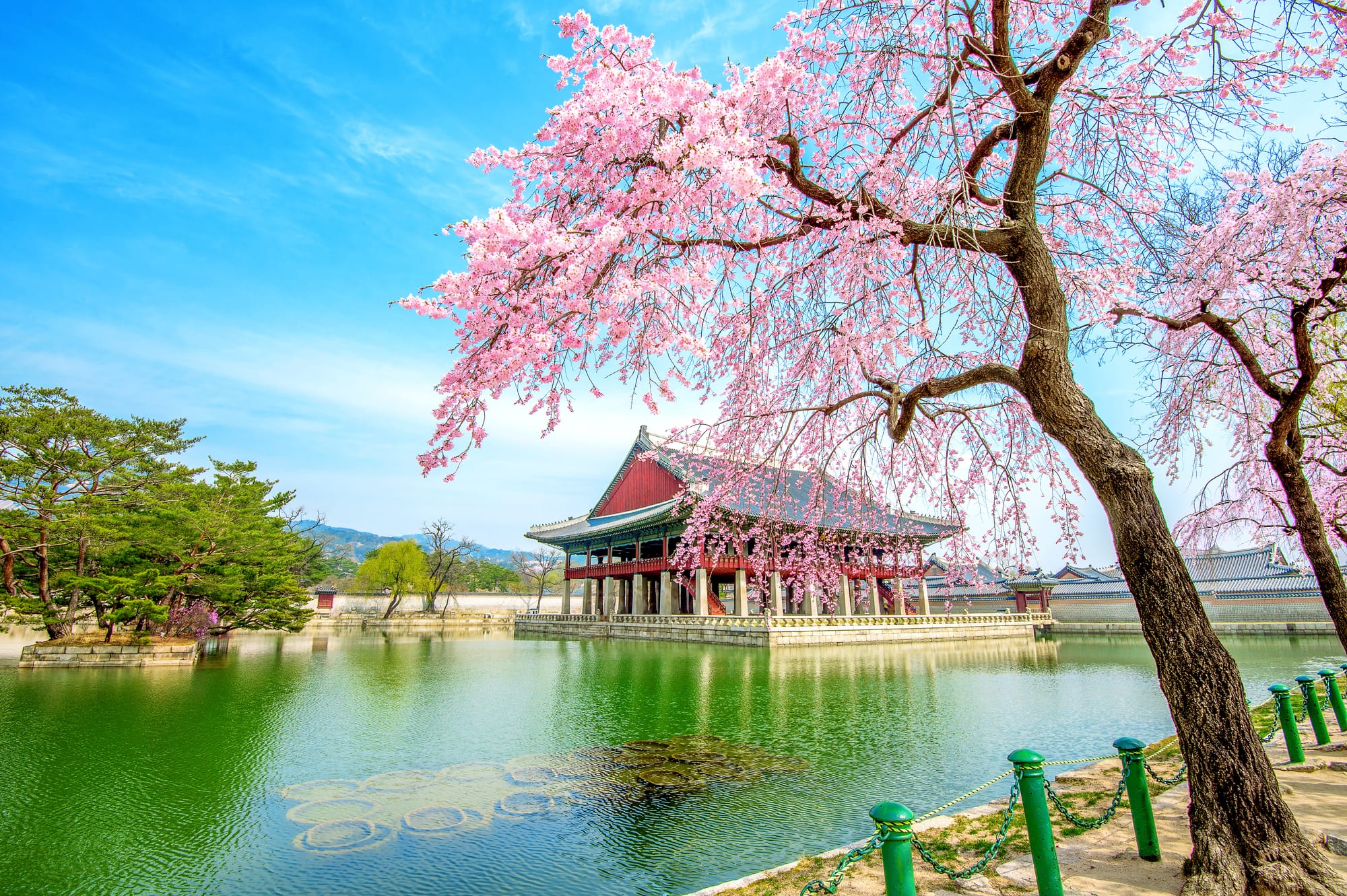
South Korea doesn't need much selling. Ancient temples sitting next to neon-lit skyscrapers. Street food that'll put other market food to shame. Mountains you can hike in the morning and be back in Seoul for dinner. Cherry blossoms in spring, snow-capped peaks in winter, and a convenience store on every corner. K-pop, K-drama, K-BBQ. The whole package.
And here's what makes South Korea genuinely perfect for young travellers: it's one of the safest countries you'll visit. South Korea consistently ranks among the world's lowest crime rates. Kids walk to school alone. The subway runs until midnight, reopens at 5am, and there are always people around. The infrastructure works. Public transport is efficient, affordable, and signposted in English. The subway gets you anywhere in Seoul for about £1. Apps like Kakao and Naver Maps make navigation simple even if your South Korean is limited to "hello" and "thank you." Everything just... functions.
The H-1 or E-2 Working Holiday visa makes all of this possible. If you're aged 18-35 (or 18-34 for some nationalities), you can spend up to 24 months living and working across South Korea. A full year. Not a quick holiday. Actual living.
Imagine This:
- Exploring the bustling streets of Seoul: Soak up the energy of one of Asia’s most exciting cities, from cutting-edge skyscrapers to centuries-old palaces.
- Hiking in Bukhansan National Park: Wander through peaceful trails and take in panoramic views just a stone's throw from the capital.
- Experiencing street food in Busan: Indulge in South Korea’s vibrant food scene, with everything from fresh seafood to spicy tteokbokki along the coast.

This guide covers who can apply, what the process involves, where you might work, which cities you could end up in, and how we take care of the paperwork headaches. Because nobody dreams about filling out South Korean government forms. You're here for the bibimbap and the adventures.
Who Can Actually Apply?
South Korea has two main visa routes depending on what you want to do and whether you've got a degree. Here's how it breaks down.
H-1 Working Holiday Visa (English Education Assistant)
For anyone who wants to work in South Korea but doesn't have a degree
The right passport?South Korea has agreements with 29 countries. If you're from Australia, Canada, New Zealand, UK, US, Japan, France, Germany, Ireland, or a bunch of others, you're likely sorted. Enquire with us and we'll confirm your passport checks out.
Right age?
- 18-35: British, Canadian
- 18-34: Irish, Argentinian, Brazilian, Chilean, Danish, German, Portuguese, Taiwanese
- 18-30: Everyone else
First time?This is a one-time opportunity (which makes it even more special).
Travelling solo?This visa's just for you, no plus ones. Think of it as your personal adventure.
Applying from home?You'll need to apply from your home country. Perfect excuse to sort everything before you go.
E-2 Teaching Visa (Professional English Teacher)
For anyone with a degree who wants to teach English professionally
- Right passport?You need to be from a native English-speaking country: USA, UK, Canada, Ireland, Australia, New Zealand, or South Africa.
- Right age?Typically 20-35, though some schools may hire outside this range.
- Got a degree?Bachelor's degree required (any major works). This is non-negotiable for the E-2 visa.
- Clean record?Criminal background check required. Minor stuff is usually okay, serious convictions are a problem.
Employer sponsored
Your teaching school sponsors your visa. We help match you with schools, they handle the visa sponsorship process.
What You Need to Bring
Every embassy's slightly different, but don't worry, we ensure you've got the right paperwork for your specific embassy and that you're working with the most current requirements.
What You Need & Application Process
Both visas require similar base documents. We ensure you've got the right paperwork for your specific embassy with the most current requirements.
Standard for both:
- Valid passport (6-12 months validity)
- Passport photo
- Visa application form
- Criminal background check
- Medical/health certificate and insurance
- Visa fee
H-1 specific additions:
- Bank statement (KRW 3 million / £1,800-2,000)
- Return flight itinerary
- Travel plan document
- Travel insurance
E-2 specific additions:
- Bachelor's degree (apostilled)
- University transcripts (apostilled)
- TESOL certificate (from your 4-week course)
- Employment contract from school
- Background check must be apostilled and within 6 months
Timeline: Enquire 6-12 months before travel because processing can take several weeks.
Things Worth Knowing
- A bit of Korean goes a long wayEven basics like "hello," "thank you," and "how much?" make everyday life easier. Plus, most jobs prefer people who can chat in Korean.
- Insurance is importantYou'll need solid coverage. Good travel insurance is kind of a mandatory must when travelling anywhere. It gives you, and your family back home, peace of mind.
- Book appointments earlyPopular times get booked up fast. Sorting it early means you're not waiting around.

Working Holiday in South Korea
If we’ve painted the picture and sold you the dream - K-pop Fridays are just around the corner! You just need to decide how you want to do this thing. Now, you've got a few options. Go solo and figure it all out as you go (which, let's be real, can get a bit chaotic). Or go with one of the curated and supported trips we’ve designed which handles all the stressful bits so you can focus on the exciting stuff from day one.
Global Work & Travel's South Korea Working Holiday options are perfect for people who want the full adventure with none of the admin headaches. The cultural immersion, the job security, the new friends, the epic experiences, all sorted before you even land.
What Both Options Include:
- Your own Trip Coordinator
- Private airport pickup/transfer
- Cultural experiences – Cooking class, palace tours, Hanbok experience, welcome dinner with other Global Travellers
- Access to to our gWorld app - keep all documents in one central hub
- Ongoing support 24/5 emergency line, Monday - Friday
Working Holiday (No Degree Required)
Perfect for: Ages 20-35 who want to work in South Korea without a degree
Work as an English Education Assistant. Earn 1,200,000-1,400,000 KRW/month ($850-1,000 USD). Need: Fluent English, 6 months work experience, clean record.
What you'll actually be doing:
Most roles are English Education Assistant positions at language schools. Think less "formal teacher" and more "helpful English-speaking human who makes kids' days better." Your day might include:
- Riding the school bus with students (yes, really, it's part of the gig)
- Greeting students and parents at drop-off and pick-up
- Helping students during break times (basically being the cool friend who speaks English)
- Assisting teachers with lesson planning and creating materials
- Having lunch with students and chatting in English
- Checking attendance
- Playing board games or hanging out with early arrivals between classes
- Helping tidy classrooms before or after class
- Creating content for the school's social media (some schools love this)
Some positions get creative, we've had assistants working as baristas in an in-house cafe at larger school branches. Basically serving coffee while casually practicing English with students and parents. Not bad, right?
There are also English Companion roles (limited availability), essentially tutoring English and looking after one or two kids for a local family. Roughly the same pay, same accommodation support, different vibe.
Where you'll be:
Most placements are in the greater Seoul, Gyeonggi-do, and Incheon areas (essentially the Seoul metro region). Some are elsewhere in South Korea. We take your preferences into account, but we can't guarantee specific locations, it depends on where schools need people.
What's different:
- Job match before you leave – Have the ease and support to ensure you’re making money when you arrive
- Four nights accommodation included – Top-rated backpacker accommodation in central Seoul/Incheon to settle in
- Help finding permanent accommodation – Many jobs include subsidised staff housing. If not, our local team will assist
- 6-month minimum contract – Giving you loads of time for exploration!
Teach English (Degree Required)
Perfect for: Ages 20-35 with a degree who want to teach professionally
Complete your TESOL certification (4 weeks, included), then teach full-time. Earn $1,500-1,750 USD/month (12-month contracts) or $1,250-1,550 USD/month (6-month contracts).
What's different:
- TESOL certification included – 120-hour internationally recognised course in Incheon plus accommodation during course included (twin-share)
- 95% job placement rate – Team arranges interviews post-TESOL. 95% land positions within 2 weeks
- Flight reimbursement – 12-month contracts include flight reimbursement
- School-provided benefits – Private studio apartment organised and paid by school. Medical insurance covered by school
- Interview preparation – Team preps you for teaching interviews so you walk in confident
Who qualifies: Ages 20-35. Bachelor's degree (any major). No teaching experience needed (TESOL covers it). No criminal record.
*Please note that 1-month duration is only the 4 week in-country TESOL course. Optional teaching job matches require an additional minimum commitment of 6 months.
Travel and Adventure Tips
The Classics You Can't Skip
Seoul's bustling streets where ancient palaces sit next to Samsung billboards. Gyeongju's historic sites that make you feel like you've time-traveled. Busan's temples perched on cliffs with ocean views that don't look real. These are the spots everyone talks about because they're genuinely brilliant.
The Hidden Gems That'll Make You Feel Smug
Boseong's tea fields, rolling green hills that look straight out of a screensaver. Ulsan's Daewangam Park with dramatic cliffs and zero crowds. Seoraksan National Park's peaks that'll have you wondering why you ever bothered with a gym membership. These are the places that make your mates back home jealous.
Off-the-Beaten-Path Adventures
Jeju Island for volcanic landscapes, waterfalls, and that "I'm on a tropical island but also South Korea" vibe. Jirisan's remote trails where you can properly escape and pretend your phone doesn't exist. This is the South Korea most tourists miss.
Getting Around (It's Ridiculously Easy)
South Korea's public transport is so good it'll ruin you for every other country. High-speed KTX trains whisk you between cities faster than you can finish your coffee. Buses go everywhere. Subways are spotless and actually run on time.
Want flexibility? Rent a car and explore at your own pace. Just know that driving in Seoul is a special kind of chaos.
Pro tip: Get a T-money card (works on buses, subways, taxis, even convenience stores). Ask locals for recommendations—they'll send you to the best spots that aren't in any guidebook. South Korea's small enough to explore properly but big enough to keep surprising you.
Travelling to Asia from Outside of South Korea
One of the great advantages of being on a South Korean Working Holiday Visa is South Korea’s strategic location in Asia, making it an ideal hub for exploring the rest of the continent. Here’s how you can make the most of your time and travel beyond South Korea:
- Proximity to Major Destinations: South Korea is well-connected to neighbouring countries like Japan, China, Taiwan, and Southeast Asia, with frequent, affordable flights available from major airports like Incheon International Airport and Gimpo International Airport.
- Budget Airlines: Low-cost carriers such as Jeju Air, T’way Air, and Air Seoul offer affordable flights to various Asian destinations, making short trips easy to plan even on a working holiday budget.
- Visa Requirements: Before travelling, check the visa requirements for your chosen destination. Some countries, like Japan or Thailand, may offer visa-free entry for short stays, while others may require you to apply in advance.
Your Incheon Hit List (The Insider's Guide)
If you are doing your TESOL course for the first few weeks, you will be located in Icheon. Here's where to go and how not to waste your weekends.
The Neighborhoods
- Songdo – Modern, Instagram-worthy. Craft beer and rooftop bars. Bit pricey but worth it.
- Bupyeong – Where the energy is. More local, cheaper drinks. This is where you make South Korean friends.
- Guwol-dong – The middle ground. Less polished than Songdo, less chaotic than Bupyeong.
Bars Worth Your Time
- The Cinder Bar (Songdo) – Walk in solo, leave with five new mates. Perfect for expats.
- Incheon Brewery – Craft beer in an old warehouse. Newtro vibes. Try "Our Beer From Sinpo."
- Playground Brewery Taproom (Songdo) – Rotating craft beers, Le Cordon Bleu burgers, truffle fries. Enough said.
Pro Tips
- Noraebang costs 5,000-10,000 won/hour. BYOB allowed
- T-money card works everywhere
- Bars fill up 9pm. Clubs peak 11pm-2am
- You're 40 minutes from Seoul by KTX/subway
Weekend in Seoul (The Hot Spots)
Here's how to do Seoul properly.
Neighborhoods by Vibe
- Hongdae – Young, energetic, cheap drinks, live music, street performers. Student chaos in the best way.
- Itaewon – International, foreigner-friendly, diverse food, rooftop bars. English everywhere.
- Gangnam – Upscale, trendy, fancy clubs, bougie cocktails. Yes, that Gangnam.
- Seongsu-dong – Brooklyn meets South Korea. Hip cafes, craft beer, vintage shops, Instagram heaven.
Where to Eat
- Gwangjang Market – Street food central. Bindaetteok, mayak gimbap, live octopus if you're brave.
- Korean BBQ anywhere – Pick a place, order samgyeopsal, grill your own meat, wrap in lettuce. Done.
Bars & Clubs Worth Your Time
- Hongdae: Club NB (hip-hop/EDM)
- Itaewon: The Fountain (rooftop views), Cakeshop (underground club, electronic)
- Gangnam: Octagon (Asia's biggest club, bring your wallet), Arena (massive dance floors)
Day Stuff
- Gyeongbokgung Palace – Rent hanbok for free entry (20,000 won rental nearby)
- Bukchon Hanok Village – Traditional houses, cute cafes, views. Go early.
- N Seoul Tower – Sunset views, city lights. Cliche but worth it.
- Han River Parks – Rent bikes, picnic, convenience store beer by the water.
Pro Tips
- Last train's midnight. Miss it? Night bus, taxi, or stay out until 5am (common move)
- Some clubs have dress codes. Pack a shirt and be prepared to double your hair straightener as an iron
- Join a pub crawl in Hongdae/Itaewon. Easy way to hit multiple spots, meet other travellers
- T-money card works on subway
Seoul's 40 minutes away. You'll be back. A lot.
Final Thoughts
So there it is. Ancient temples and neon streets. Mountains in the morning, Seoul by dinner. Safe cities, efficient transport, convenience stores on every corner. Incredible food. New friends. Weekend trips across Asia. A proper adventure.
You've got two solid options when booking with us: Work as an English Education Assistant (no degree needed) or teach English professionally (degree required). Both come with job matching, cultural experiences, accommodation support, and a team that actually has your back from visa application to your last day in South Korea.
The visa's one-time for most people. This isn't something you can put off and do later. If you're thinking about it, you're already halfway there. We handle the paperwork, the job matching, the airport pickup, the settling-in bits. You focus on living there, exploring there, actually being there.
South Korea's waiting. Your spot's available. The only question left is: are you booking this or spending another year wondering what if?
Frequently Asked Questions (FAQs)
- What is the Korean Working Holiday Programme visa?
The Korean working holiday programme visa (H-1) allows young people from eligible countries to live, work, and travel in South Korea for up to one year, providing a unique cultural exchange experience.
- Who is eligible for the Korean Working Holiday Programme visa?
Applicants must be between 18-30 years old at the time of application and hold citizenship from a country that has a bilateral working holiday agreement with South Korea. Countries include Australia, Canada, New Zealand, the UK, Japan, and others.
- How long does the Korean Working Holiday visa last?
The H-1 visa is valid for 12 months, during which you can live, work, and travel in South Korea.
- Can I extend my Korean Working Holiday visa?
No, the H-1 visa cannot be extended or renewed. Once your one-year stay ends, you must leave South Korea or apply for a different visa if eligible.
- What jobs can I take with this visa?
You can work in many sectors such as hospitality, retail, and tourism. However, certain professions, such as doctors, lawyers and pilots, are restricted unless you have the appropriate South Korean qualifications. Jobs in adult entertainment are also prohibited.
- How do I find a job in South Korea?
You can search for jobs through online platforms such as JobKorea, WorknPlay or by accessing our online app.
- Do I need an Alien Registration Card (ARC) to work in South Korea?
Yes, you must apply for an ARC within 90 days of arrival. This card is essential for legal employment, opening a bank account, and other services.
- How do I set up a bank account in South Korea?
Major banks such as KEB Hana Bank, Shinhan Bank, and Woori Bank offer accounts for foreigners. You will need your passport, Alien Registration Card (ARC), proof of address, and possibly your visa details to open an account.
- Do I need health insurance in South Korea?
Yes, you must have health insurance during your stay. You can enrol in South Korea's National Health Insurance (NHI) once you have your ARC, or you can use private health insurance if preferred.
- What is the best way to get around South Korea?
South Korea has an efficient public transport system, including subways, buses, and high-speed trains (KTX). A T-money card is useful for convenient access to public transportation across the country. Renting a car is also an option for road trips.
- How do I manage taxes in South Korea?
Your employer will automatically deduct taxes from your salary. You may need to file a tax return at the end of the tax year if you are self-employed or have specific deductions to claim.
- What’s the average cost of living in South Korea?
The cost of living varies depending on the city. Seoul is the most expensive, while cities like Busan, Daegu, and Gwangju are more affordable. Key costs include rent, groceries, and public transport.
- Can I study while on the Korean Working Holiday visa?
Yes, you can take part-time or short-term courses during your stay, but you won’t be eligible for student visas or financial aid.
- Can I travel outside South Korea and return while on this visa?
Yes, you can leave and re-enter South Korea as long as your visa remains valid. Be sure to carry your Alien Registration Card (ARC) and passport when travelling.
- What happens when my Korean Working Holiday visa expires?
Once your visa expires, you must leave South Korea. If you wish to stay longer, you’ll need to explore other visa options, such as a work visa, student visa, or sponsored employment visa, depending on your eligibility.
If you want to learn about the digital nomad visa's for other countries, we have extensive guides for countries like the United Kingdom, Germany, New Zealand, Italy, Portugal, Spain, Thailand, and Japan.
We also publish extensive working holiday visa guides for United States, Canada, Australia, United Kingdom, Germany, France, Spain, Italy, Ireland, Korea, Argentina, Chile, Hong Kong, Estonia, Netherlands, Austria, Slovakia, Portugal, Peru, Greece, Singapore, Malaysia, Taiwan, Mongolia, New Zealand, Ecuador, Brazil and more coming.

Jessie Chambers
Jessie is a globetrotter and storyteller behind the Global Work & Travel blog, sharing tips, tales, and insights from cities to remote escapes, informed by the collective experience and real-world knowledge of teams across our business.