



Just You, a Plastic Stool, and Thailand: The Solo Travel Guide
by Jessie Chambers 2 months ago
9 MIN READ
Chiang Mai at half seven in the evening does something to people and we cannot fully explain it. The heat has finally let go. The night market is warming up. You're sitting on a plastic stool that is objectively too small, eating something you pointed at rather than named, and the woman who cooked it has already worked out you're on your own and has opinions about what you should try tomorrow.
Nobody is looking at you strangely. That's the thing that surprises people most. In Thailand, eating alone is not a spectacle. It's just Tuesday.
This is a country where solo travel has been normal for so long that the whole infrastructure quietly assumes you might be by yourself. Single-portion food. Hostels with common rooms designed for exactly this. Transport that runs without you needing to book a companion. Other people doing the same thing, everywhere, constantly.
None of which means you should go in unprepared. So here's the honest version: what's actually risky, what isn't, where to put yourself, and how to end up finding your travel tribe and the alternative to going at it alone, and solo travel options that are organised, planned and sorted all for you.
Is Thailand Good for Solo Travel?
Yes, Thailand is one of the easiest countries in the world to travel alone, particularly for a first solo trip. English is widely spoken in tourist areas, the backpacker infrastructure is decades old and genuinely well developed, transport between major destinations is cheap and frequent, and the volume of other solo travellers means you're rarely alone unless you want to be.
The main risks are not what most people worry about:
- Road accidents are the biggest danger, particularly motorbikes. Thailand has one of the highest road accidents rates in the world.
- Scams are common but financial rather than violent, and almost all of them are avoidable once you know the shapes.
- Drink spiking are real risks in nightlife areas and worth taking seriously.
Violent crime against tourists is comparatively rare. Prepare for the road and the drinks, not for the movie plot.
How Safe It Actually Is
The Australian Government's Smartraveller advice for Thailand is worth reading in full before you go, and your own government will publish an equivalent. The specifics below come from it.
On the road. This is the section that matters most and the one people skim. If you have a motorcycle accident in Thailand you could be held responsible for damages, loss or costs associated with injury to others, and your embassy cannot help you negotiate compensation demands. Many travel insurance policies exclude motorbike accidents unless you hold the correct licence, which means an uninsured rider facing a compensation demand is a genuinely bad situation to be in alone. If you have never ridden before, Thailand is not the place to learn.
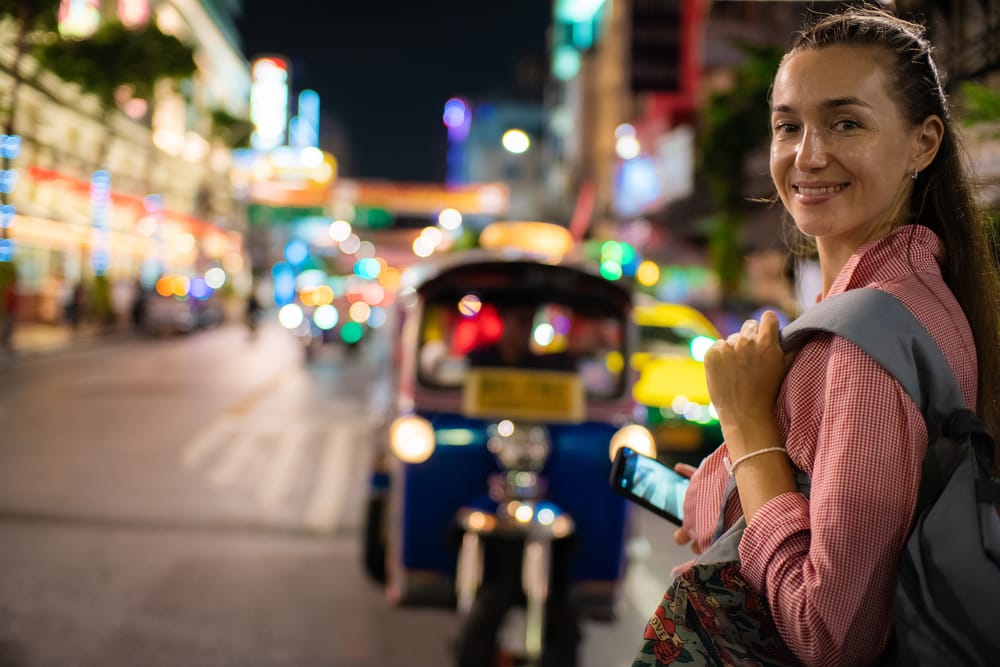
On scams. The pattern to recognise is the friendly approach that leads somewhere you didn't intend to go. Be wary of apparently friendly taxi or tuktuk drivers offering cheap tours, since they may take you to shops where they earn commission and you may be overcharged or sold worthless goods or gems.Two habits solve most of it: insist on the meter in official taxis and check the driver's identification card is visible, and agree the fare and the route before getting into any unmetered taxi, tuktuk or motorcycle taxi. One more that catches solo travellers specifically: never hand over your passport as a deposit or guarantee, which is most often asked for at scooter rental shops.
On nightlife. Drink spiking can happen anywhere, so watch your drink being mixed, don't leave food or drinks unattended, and don't accept drinks or cigarettes from strangers. The one that gets underplayed is methanol. Methanol is highly toxic, as little as one shot can be fatal, and it can be added to or accidentally created in poorly produced alcohol, so stick to branded sealed drinks and get urgent medical help if you suspect poisoning. Travelling alone removes the friend who notices you've gone quiet, which is exactly why this belongs in a solo article rather than a general one.
Practical numbers. Thailand has a dedicated tourist police line in 1155, staffed to deal with exactly the situations travellers get into. Save it before you land.
Check your own advisory. Advisory levels and specific regional warnings change, sometimes quickly. Read your government's current advice close to departure rather than relying on any article, including this one.

Solo Female Travel in Thailand
Thailand is one of the most popular solo female travel destinations on earth, and the reasons are structural rather than sentimental: an enormous existing community of women doing the same thing, accommodation built around meeting people, and a culture where a woman eating or travelling alone attracts no particular attention.
That said, the sensible adjustments are the same ones you'd make anywhere:
- Chiang Mai is the softest landing. Compact, walkable, a large long-term international community, and far less hassle than the beach party towns.
- Accommodation with a common area beats a cheap private room for the first few days, because it solves the social question without you having to work for it.
- Share your itinerary with someone at home and check in on a loose schedule.
- Nightlife caution is not paranoia. The drink advice above applies double when nobody is tracking your night.
- Dress for temples, not for the internet. Shoulders and knees covered on temple grounds, and Thailand takes both Buddhism and the monarchy seriously.
Zoom out and the picture is straightforward: the country is welcoming, the risks are known and manageable, and the number of women who do this every year runs into the millions.
Where to Base Yourself Solo
Chiang Mai is the answer for most first-time solo travellers. Walkable old town, cheap and excellent food, a huge community of people who arrived for two weeks and are still there, and easy access to mountains and villages. It is the least intimidating major city in the country.
Bangkok rewards you for staying longer than the two nights everyone allocates it. Overwhelming on arrival, then suddenly navigable once you work out the river boats and the metro. Good for solo travellers who like cities and don't need to be handheld.
Pai is a small mountain town three hours north of Chiang Mai on a road with several hundred bends. It's tiny, social, and the kind of place where you meet the same six people repeatedly over four days until you're friends.
Krabi and the Andaman islands are more couple-heavy than the north, but the boat trips and dive schools throw solo travellers together constantly.
Two streets over from any of these, the whole country changes character again, which is really the argument for moving around rather than settling.
How to Actually Meet People
You will not have to try very hard. That's the honest answer and it undersells how much easier it is here than almost anywhere.
- Cooking classes are the single most efficient social hour in Thailand. Everyone is bad at it, everyone eats together afterwards.
- Dive courses produce three-day friendships that outlast the trip. Koh Tao runs on this.
- Hostel common rooms in Chiang Mai, Pai and Bangkok are functionally a matching service.
- Overnight buses and boat transfers are where you end up in a nine-hour conversation with someone from Belgium.
- Muay Thai gyms take drop-ins, and the beginner class is full of people in exactly your position.
You will develop opinions about mango sticky rice. Strong ones. Within a fortnight. Apologies in advance to everyone who has to hear about it when you get back.

Getting Around on Your Own
- Domestic flights are cheap and save a full day compared to the bus between Bangkok and Chiang Mai.
- Trains are slow, scenic and sociable. Sleepers are a genuinely good experience.
- Buses cover everything, though quality varies enormously. Book through your accommodation rather than a street agent.
- Grab works in cities and removes the entire taxi negotiation problem.
- Scooters are how most people get around islands and small towns, and they are also the single biggest source of serious injury. Helmet, licence, insurance that covers you. If any of those three is missing, don't.
Which Getaway Works Best Solo
If the appeal of solo travel is the freedom and the daunting part is the logistics and the first three days, a small-group trip splits the difference. You arrive alone, you just don't have to be alone on arrival.
The Getaways range is unusually well suited to this, and not by accident. Around 90% of travellers on these trips are solo, everyone is aged 18 to 35, and the trips are run by Global Work & Travel rather than resold from another operator.
What that means in practice, from the trip pages themselves:
- Rooming: twin-share at selected 3 or 4-star hotels rather than dorms. Booking alone means being matched with another traveller of the same gender. A private room upgrade is available on each trip at additional cost, subject to availability.
- Before you fly: you get access to Social and a WhatsApp group with your group, so the first conversation happens weeks before the first day.
- On arrival: airport meet and transfer, and a Global Guide with the group throughout.
- Insurance: travel medical cover through Global Travel Cover for the scheduled duration of the trip. Read the next section carefully, because the boundaries matter more when you're travelling alone.
Two Thailand trips, eight days each, both running November to April.
Northern Thailand Hidden Kingdom. Bangkok by tuk tuk and canal boat, the Grand Palace and Wat Pho, then north to Chiang Mai for Doi Suthep and the night markets, an ethical elephant sanctuary, and the mountain road up to Pai for limestone caves, underground rivers and hot springs. It finishes with a cooking experience and dinner in a local family's home. There's a full free day in Chiang Mai built in, which is the detail solo travellers should look for: structured enough to remove the planning, loose enough that you still get a day to yourself.
Southern Thailand Lost & Found. Phuket's quieter viewpoints and beaches, bamboo rafting near Khao Lak, mangrove kayaking and a jungle dinner cooked over open fire at Tha Din Daeng village, a long-tail boat day on Cheow Lan Lake with lunch on a floating raft house, then island hopping around Krabi. Also has a free day near the end. Every stop is on the Andaman side, which is why it runs November to April.
Both are also available as part of longer routes: Ultimate Thailand: North to South covers both halves across 15 days, and Ultimate Thailand & Vietnam runs 29 days across two countries.
Where these trips are honestly the wrong call. The trip pages say it themselves: they're not built for people who want a highly structured, fast-paced tour, and they're not built for luxury travellers. If your version of solo travel is changing plans on a whim and staying somewhere an extra week because you liked it, a fixed eight-day route will chafe. Thailand is also genuinely easy to do independently and cheaper that way. What you're buying is the removal of the hardest part, which for most solo travellers is the first 72 hours and the question of who to eat dinner with.
Money and What Catches Solo Travellers
- Cash still rules outside the cities. Cards work in Phuket, Bangkok and Krabi. Night markets, rural villages and floating raft houses do not.
- ATM fraud happens. Card skimming is a known issue in Thailand, so use machines attached to banks and check your statements.
- The solo premium is real. Accommodation is priced per room, not per person, so travelling alone costs more per night than splitting with someone. This is exactly what twin-share on a group trip removes.
- Budget for the gaps around a booked trip. Flights, departure airport transfers, visas, vaccinations, local tourist taxes, meals not listed and daily spending are all on you.
- Insurance beyond the trip window. The cover included with a Getaway runs for the scheduled trip duration and is a base medical policy. It excludes pre-existing conditions and does not cover cancellation or travel outside your trip dates. If you're flying in early, staying on afterwards, or crossing into Laos or Cambodia for a week, that's uncovered time. Global Travel Cover, the sister brand in the Global Work & Travel family, is built for those edges. For a solo traveller with nobody to lean on, this is not the line item to skip
Ready to Go?
If you want the freedom of going alone without the first-week friction, the eight-day Northern Thailand Hidden Kingdom and Southern Thailand Lost & Found trips are built for exactly this: a group of people your age who also came on their own, a room that isn't a bunk in a dorm of twelve, and someone else deciding which boat actually runs today. Departure dates and current pricing sit on each trip page.
Then it's just you, a plastic stool, and something you pointed at.
Final Thoughts
The thing nobody tells you about going alone is that you will spend approximately four days being quietly proud of yourself for managing a bus, and then you will stop noticing that you're doing it at all. That's the shift. Somewhere between the airport panic and the second week, "travelling solo" stops being a thing you're doing and just becomes travelling.
Thailand is a very forgiving place to have that happen. The food is good, the people are patient, the buses turn up, and there is always someone else at the table who arrived on their own too.
So the only real question left is which month.

Jessie Chambers
Jessie is a globetrotter and storyteller behind the Global Work & Travel blog, sharing tips, tales, and insights from cities to remote escapes, informed by the collective experience and real-world knowledge of teams across our business.