



How to Build a Social Life and Find Community While Teaching English in Southeast Asia
by Jessie Chambers 2 months ago
8 MIN READ
You've got the job. You've got the visa. You've got a flight, a class of kids who will find your accent hilarious, and a whole country waiting to be explored on your days off. The big pieces are sorted. What's left is the fun part: building an actual life, which in Southeast Asia means building a crew. So here's the shortcut we'd give a mate over coffee, before anything else: stay somewhere social. And when we say somewhere social, we mean Mad Monkey, our exclusive travel partner and the only hostel group we'd send a first-timer to without a single caveat attached. Around 25 properties across Cambodia, Thailand, the Philippines, Indonesia, Laos, Vietnam and Australia, and nobody in the region is better at the one thing that actually matters here: getting strangers talking.
We’ve been doing this a while, and we know what young people want out of their hostel experience - max vibes. Exclusive to our community: book direct, use GLOBALWORKTRAVEL10, keep 10%.
Where You Stay Decides Who You Meet
Picture a Tuesday. Not a weekend. A Tuesday.
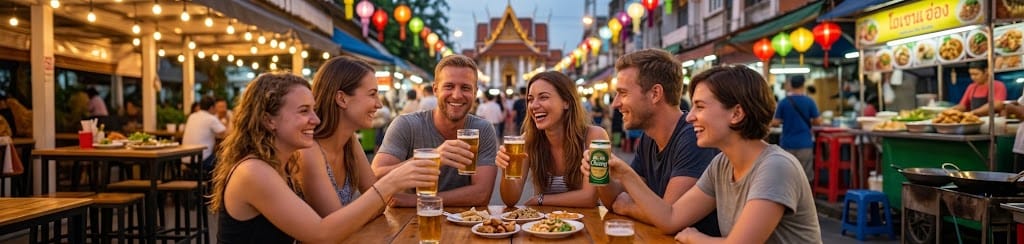
You've come off a day of teaching, dumped your bag, and you're in a saltwater pool by four with six people whose names you learned an hour ago. Somebody's rounding up a group for the night market. Somebody else has booked a sunrise thing and is recruiting aggressively. There's Music Bingo at the bar tonight, a pub crawl leaving later that you'll join for "one," and a cooking class in the morning that half the table signs up for on the spot.
That's a normal Tuesday at a Mad Monkey. The pools, the bars, the tours, the nightly events, the island trips, all of it exists for one reason: so that nobody has to be brave.
Because that's the real barrier. Not shyness, logistics. Walking into a room of strangers and generating a conversation out of nothing is a lot to ask of anyone at the end of a work day. Turning up to a thing where everyone came for the same reason is not.
Chiang Mai is the hottest example. A daily 7pm get-together at the bar called The Meet Up, 50% off beers, every single day. You don't need charm. You don't need a plan. You need to be downstairs at seven. Elsewhere it's pool parties, beer pong tournaments, karaoke, walking tours, island hops and the kind of family-style dinners where you sit down next to a stranger and stand up with a travel buddy.
The Map Is the Whole Point
One night in one hostel is a good night. The reason to stick with one network all year is what happens across the other fifty-one weekends.
You meet people in Chiang Mai. Three weeks later half of them are in Pai. Someone messages the group chat about Siem Reap and suddenly six of you are watching the sun come up over Angkor. That only happens when you're moving through the same network, because that's what turns a nice weekend into an actual social circle.
- Thailand: Bangkok, Chiang Mai, Pai and Phuket. Your weekend circuit, all within a cheap flight or an overnight bus of each other.
- Vietnam: Hanoi and Hoi An, where you will accidentally order three custom suits.
- Cambodia: Siem Reap and Phnom Penh, which is Angkor at sunrise with people you met over breakfast.
- Laos, the Philippines and Indonesia: Luang Prabang, Vang Vieng, Siargao and Gili Trawangan. The ones you add once you've caught the bug, which you will.
Every trip starts warm instead of cold. You turn up somewhere new on a Friday knowing nobody and leave on the Sunday with the next one already booked. Booking direct is the better move too: it's where the loyalty perks and free nights live, and it's the only place the community code works.
The Reviews Speak for Themselves
We'd tell you Mad Monkey is the best in the region regardless, because we would, but you don't have to take our word for it. The group averages around 9.5 out of 10 across its properties on the top Hostel sites, which for a network of this size is genuinely hard to pull off. Anyone can run one great hostel. Running twenty-three of them at that standard is the whole trick.
The standouts as things stand:
- Mad Monkey Koh Sdach: 9.9
- Mad Monkey Gili Trawangan: 9.9
- Mad Monkey Siem Reap: 9.8
- Mad Monkey Uluwatu: 9.8
- Mad Monkey Phuket Patong Beach: 9.8
- Mad Monkey Chiang Mai: 9.7
- Mad Monkey Bangkok: 9.7
- Mad Monkey Pai: 9.3
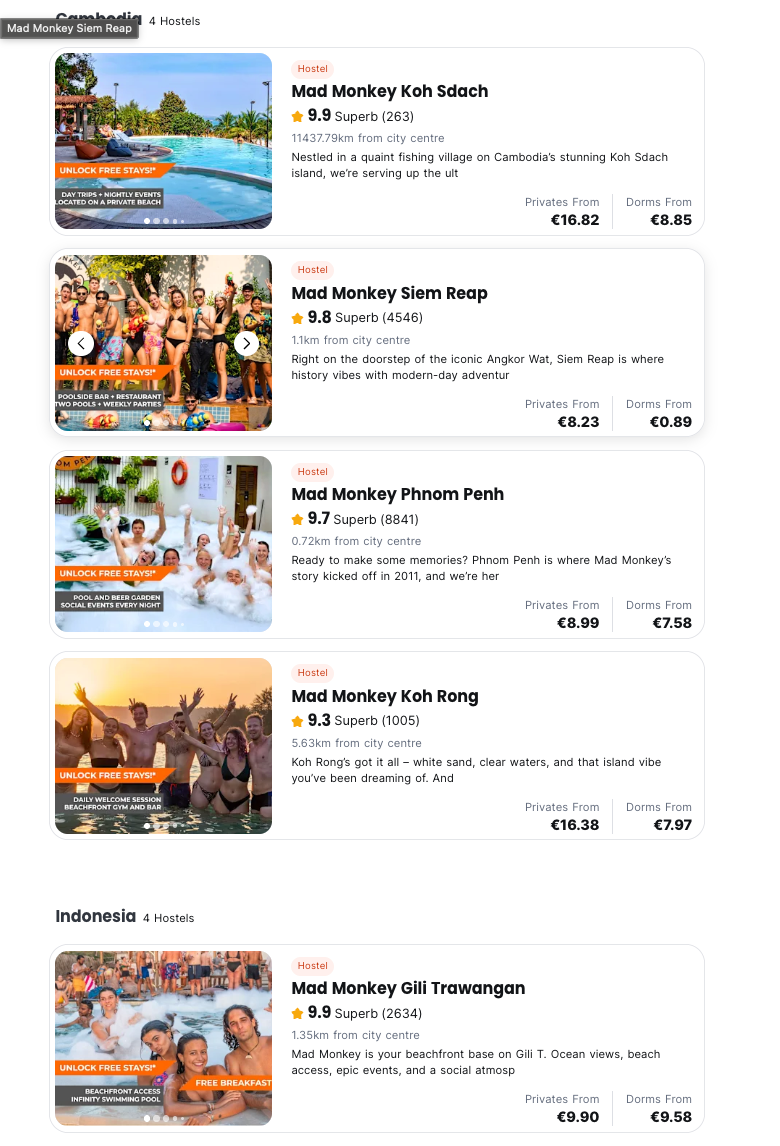
Ratings shift as new reviews land, so treat these as a snapshot rather than a fixed scoreboard. Checked August 2026. What doesn't shift is the pattern underneath them: read the reviews at any property and people are talking about the staff and the atmosphere long before they mention the beds. That tells you exactly what the group is all about.
Which is why this is the address you want on your arrival form. Not the place you end up, the place you aim for. You land, you drop your bag, and the fun starts immediately.
Book direct with the code GLOBALWORKTRAVEL10 for 10% off, at any property, all year.
Start With the People Already on the Ground
The fastest way into a social circle abroad is to find people who arrived six months before you did, because they've already made every mistake you're about to make.
If you're travelling with Global Work & Travel, that's what gWorld is for. It works like any social feed: post something, comment on other people's, join the group for your destination. The difference is that everyone in there is either heading where you're heading or already living there.
Use it for the practical stuff:
- Before you fly: find people on your intake and work out who's landing the same week.
- Once you're there: ask which neighbourhoods are worth living in and which ones just look good online.
- For weekends: find the four other people who also want to be in Siem Reap in October, then book the same hostel.
That last one is the move most people miss. A weekend trip you organise with three others from your intake is how a group chat becomes a friendship group.
Your School Is a Network, Not Just a Job
Your colleagues are the highest-frequency people in your life abroad. You see them five days a week, which is more contact than most friendships back home get.
Other international teachers are usually in exactly the same position: new, keen, and quietly hoping somebody else suggests something. Local colleagues are the ones who'll take you to the food you'd never have found and explain the festival you didn't know was happening.
The invitations that work are small. Coffee after the last class. A walk through the night market. One person asking one other person to do one thing on a Thursday. Friendships abroad are built on repetition rather than grand plans, and the person who suggests the small thing is the person everyone ends up organising around.
Say Yes on Purpose
Here's the bit we'd put in bold if we were allowed to put things in bold mid-sentence.
Your year abroad is decided by a few dozen tiny moments where somebody asks if you're coming and you have to answer immediately. The cooking class. The 6am minivan. The birthday of someone you met on Tuesday. Half of those you'll want to skip because you taught all day and your feet hurt.
Go anyway. Not every time (unless you are a raging extrovert, hit the gas then, you animal). But more often than feels natural, especially in the first two months, because that's the window where a yes turns into a standing invitation.
The trick is stacking the odds so saying yes is easy. That's genuinely why the hostel choice does so much heavy lifting. When there's already something happening downstairs at seven, you're not summoning motivation from nothing. You're just going downstairs to temp check if you want in or not. Literally, it’s on your doorstep, all you have to do is decide if it’s a yay or a nay.
Make It a Routine, Not a Highlight Reel
Big trips are great. Routine is what actually makes somewhere feel like home.
The teachers who settle in fastest tend to have three or four things that repeat:
- A weekly language exchange: free, everywhere, and the fastest way to meet locals your age.
- A regular sport or class: Muay Thai, football, run club, climbing. Recurring beats one-off every time.
- One cafe you go back to: by week three they'll know your order, and that small recognition does more for feeling settled than people expect.
- A standing Friday thing with colleagues: same bar, same time, no organising required.
- A monthly weekend away: something to point at when the weeks blur.
Pick two or three you actually enjoy. A calendar stuffed with things you're forcing yourself to attend is just a second job.
Travel Is Where Friendships Set
A weekend away does something a hundred lunch breaks can't. Two days navigating an unfamiliar city together turns a colleague into a proper friend, which is why the teachers with the best social lives are almost always the ones who travel most on their days off.
Southeast Asia makes this genuinely easy. Cheap flights, overnight buses, and school holidays that leave you real time to use:
- Island hopping through southern Thailand or the Philippines
- The temples at Angkor, ideally at sunrise, ideally with a group
- Northern Vietnam for mountains and motorbikes
- Waterfalls and rivers in Laos
- Food weekends in Hanoi, Bangkok or Phnom Penh
Booking into the same hostel network across those trips is what compounds it. You already know the format, you already know there'll be an event on, and you already know the vibe on arrival. That's the whole reason Mad Monkey works as a base rather than a one-off: you're not gambling on a new place every month, you're moving through a network that's built for exactly this type of experience.
Make Friends With Locals, Not Just Travellers
The expat bubble is comfortable and it's a trap. Everyone inside it is on a twelve-month clock, and a social life made entirely of people who leave in June is a social life you rebuild every year.
Local friendships are what make a place stick. Learn enough of the language to be polite and slightly embarrassing. Say yes to the wedding, the family lunch, the festival your colleague mentions in passing. Nobody expects fluency, and the effort itself is usually the thing that opens the door.
The best version of a year abroad has all three: local friends, other teachers, and the rotating cast of travellers who pass through. The travellers make it fun. The locals make it home.
How You Get There Matters Too
Worth saying plainly: arriving with a group is easier than arriving alone, and certified teaching trips run as group intakes.
- Teach English in Thailand (Hua Hin): a 120-hour TESOL over four weeks, twin-share accommodation, with a first week of Muay Thai, market tours, a cooking class and a beach dinner with your whole intake.
- Teach English in Cambodia (Hua Hin TESOL): the same Hua Hin course, then the group moves to Cambodia together for orientation in Phnom Penh.
- Teach English in Vietnam (Ho Chi Minh City Orientation, Hua Hin TESOL): orientation week in Ho Chi Minh City first, welcome dinner included, then a three-week TESOL in Hua Hin with a larger cohort.
Plenty of teachers organise this independently and it works. Going with an intake just means the friendships start before you've unpacked.
Your First Booking Is the One That Matters
Everything above comes down to one decision you make before you land: where you're staying.
Get that right and the rest follows almost by itself. You arrive, there's something on that night, and by the weekend you have people to travel with. Get it wrong and you spend a month working out how to meet anyone.
So make the easy call. Pick the place built for it, put your name on the arrival form, and let the year start the moment you drop your bag.
Book direct with Mad Monkey and use GLOBALWORKTRAVEL10 for 10% off your stay, at any property across Southeast Asia.

Jessie Chambers
Jessie is a globetrotter and storyteller behind the Global Work & Travel blog, sharing tips, tales, and insights from cities to remote escapes, informed by the collective experience and real-world knowledge of teams across our business.