



Ethical Elephant Sanctuaries in Thailand: How to Tell the Real Ones from the Fakes
by Jessie Chambers 10 hours ago
10 MIN READ
Now, if your mental image of Thailand is islands, night markets and a scooter you probably shouldn't have hired, that's fair, but it's about a third of the picture. Thailand sits in the tropics, and the jungle starts roughly twenty minutes outside most of its cities and is home to one of the best animal line-ups on the planet.
Gibbons wake the entire forest at dawn and sound less like monkeys and more like a car alarm having a lovely time. Macaques run organised crime rings around temple car parks and will take the sunglasses off your face while making eye contact. Past the primates it's sun bears, clouded leopards, Malayan tapirs, hornbills the size of a small child, and monitor lizards strolling across Bangkok footpaths like they pay rent there. Get in the water and it's whale sharks, green turtles and manta rays.
And above all of it, the elephant. Not just ecologically, culturally. The white elephant sat on the national flag for decades, elephants turn up across temple murals and ceremonial life, and they're woven into the country's history in a way no other animal comes close to.
Which is why the next part matters. Some of the animal experiences you'll come across on holiday are not in favour of the animals. Tigers snoozing while a queue forms for photos. Slow lorises passed along a beachfront for a picture, teeth already clipped. Macaques on chains outside bars. Elephants painting canvases, playing football, or carrying two adults up a hill in thirty-four degree heat. Almost none of it exists because Thai people wanted it to. It exists because tourists kept paying for it, year after year, mostly without knowing what they were paying for.
That's also the hopeful bit. Demand built it, and demand is what's currently dismantling it.
Thailand is full of places doing it the other way. Ethical, no riding, no performing, no harm. It's also full of places that have worked out "sanctuary" sells better than "camp" and changed nothing else. So this guide is really about one skill: telling those two apart in about ten minutes, so you can book the good one and get on with the best day of your trip.
What "Ethical" Actually Means Here
The word gets used so loosely in Thai elephant tourism that it's close to meaningless on its own. Venues that offer riding call themselves sanctuaries. Venues that run bathing sessions call themselves rescues. Some genuinely started with good intentions and drifted.
So ignore the branding and watch the behaviour. It comes down to one question: is the elephant doing what it wants freely, or is it somewhat “performing?”.
Everything follows from that. If it's carrying you, it's not doing what it wants. If it's being scrubbed by a queue of strangers in a river, it's not doing what it wants. If it's painting, playing football or balancing on its back legs, it very much is not doing what it wants.
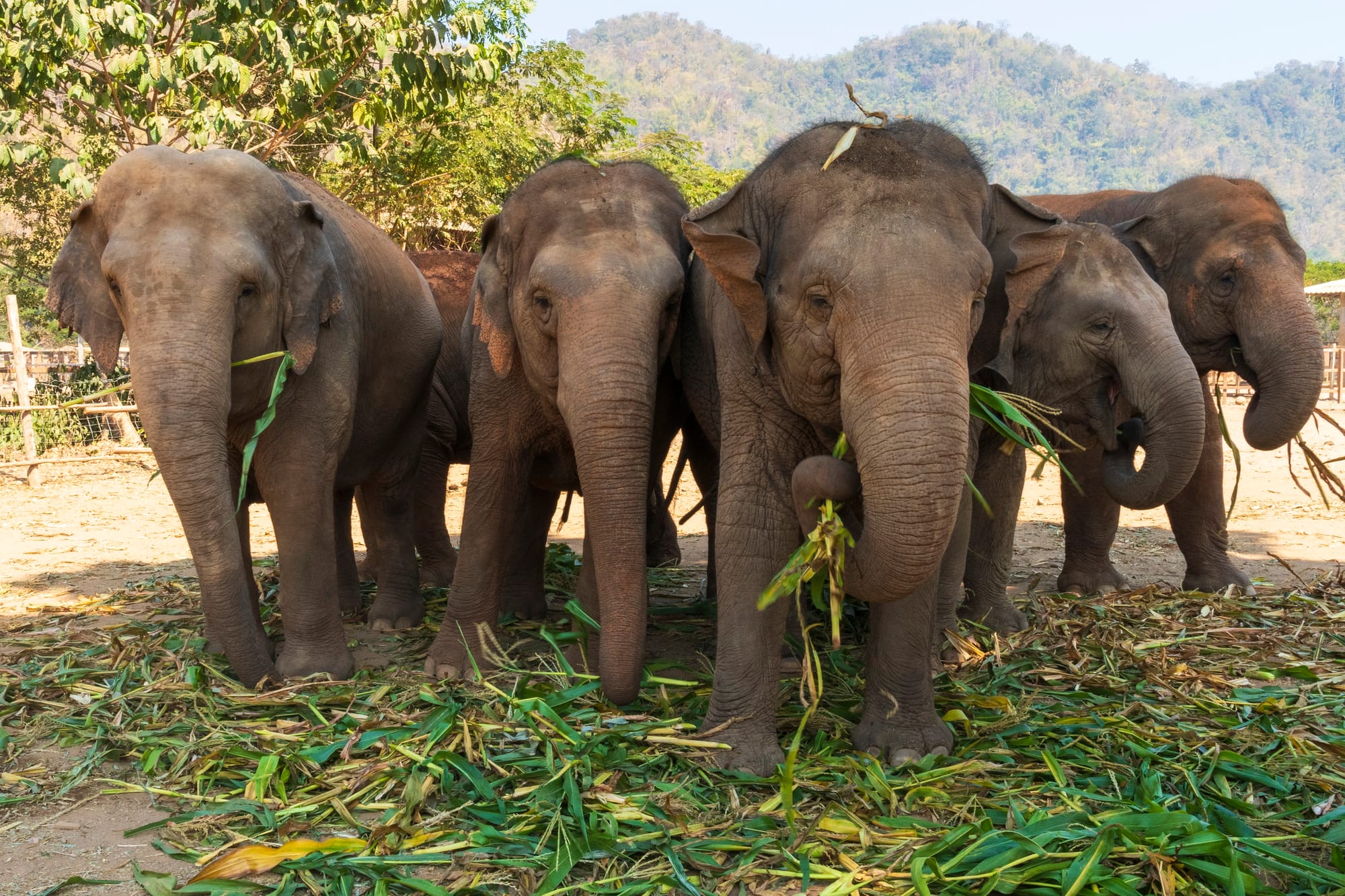
If it's eating, wandering, throwing dirt over itself, ignoring you completely and occasionally drifting close enough that you get a great photo by accident? That's the one. That's an elephant having a normal day with you as an optional extra.
Quick Summary
- What you're looking for: observation-based visits at rescue and retirement sanctuaries, not interaction venues
- The instant red flags: riding, bathing with tourists, performances, chains, bullhooks, baby elephants available for photos
- Where the good ones cluster: Chiang Mai province and the surrounding mountains
- Best time to go: November to April, Thailand's dry season, when the mountain roads are at their easiest
- How long you need: a half or full day, usually as a day trip or an en-route stop between Chiang Mai and Pai
- On a Global Work & Travel Getaway: the sanctuary visit is built into the itinerary and vetted long before you hear about it
The Bigger Picture, and the Genuinely Good News Inside It
Here's the context that makes your booking matter more than it feels like it should.
Thousands of elephants live in captivity across Thailand's tourism industry, while out in the forests the wild population is a fraction of that, and as of the 2020 assessment, the Asian elephant sits on the IUCN Red List as endangered. The gap between those two numbers is the whole story.
Captive elephants aren't a conservation population. They're a working population, employed in logging until Thailand banned commercial logging in 1989 and left thousands of animals and their handlers with no income overnight. Tourism filled the gap. That's the origin story of nearly every elephant camp in the country, and it's why "shut them all down" isn't the clean answer it sounds like. These animals eat for sixteen hours a day and someone has to pay for it.
Out in the wild, the pressure is different and it's real. Asian elephants need vast connected ranges, and Thailand's forest has been carved into fragments by agriculture, plantations and roads. When a herd's corridor disappears, the elephants come out into farmland, because the food is there and the old route isn't. Crops get flattened. Livelihoods go with them. Human-elephant conflict is now one of the biggest pressures on the wild population, and it's the kind of problem where both sides are just trying to eat.
Now the part that doesn't get enough airtime.
Thailand's forest cover has been climbing back, not falling, thanks to decades of protected-area expansion. Conservation teams are actively rebuilding wildlife corridors so herds can move between fragments again, and community programmes are helping farmers protect crops without anyone reaching for a rifle. It's slow, unglamorous, extremely effective work.
And in the tourism industry, the shift is already visible. Venue after venue has dropped riding over the past decade. Not because of a moral awakening, but because bookings moved and the money followed. Travellers did that. Ordinary ones, one booking at a time, without a single protest sign between them.
That's the encouraging bit. This is one of the rare ethical problems where the fix is already working and you can join it by choosing where to spend a day. Your money and attention is the fix, we just need to ensure we’re putting it in the right places.
Why Riding Is the Line
Quick and clear, so you can move on.
An elephant's back isn't built to carry weight, despite the size of the animal. The spine runs as a row of upward protrusions rather than the load-bearing structure a horse has, and tourist saddles sit directly on it for hours a day.
More to the point, an elephant doesn't accept a rider by choice. That compliance has to be manufactured, and it's manufactured young. Every riding photo sits downstream of that, however lovely the venue looks.
The good news is you lose nothing by skipping it. Watching a herd behave normally is the better experience anyway, and everyone who does both says so.
How to Spot a Real Sanctuary
Your field guide. Run any venue against this before you book, including the ones with the beautiful websites and the drone footage.
The immediate disqualifiers. If any single one of these is on the menu, walk away.
- Riding: with or without a saddle, "bareback" included, no exceptions
- Bathing or washing sessions: marketed as bonding, functionally a queue of strangers handling the same animal all day
- Performances: painting, football, dancing, balancing, any trick
- Baby elephants available for photos: healthy calves stay with their mothers, and a calf working a photo line was separated from one
- Bullhooks in sight: the metal hook is a pain-compliance tool, and seeing one tells you how the animal is being controlled
- Chains during the day: overnight tethering happens at some legitimate places for safety, but daytime chaining in public view is a working camp
The green flags. Harder to fake, worth actively looking for.
- Distance is the default: you watch from a set distance, and closer only happens if the elephant decides it should
- Small groups: capacity is capped, and they'll turn people away rather than run back-to-back sessions
- Herd structure: elephants live in social groups, mothers stay with calves, and animals who don't get along aren't forced together
- Serious acreage: a real sanctuary needs land, and if the whole operation fits in a car park you're looking at a camp
- They'll tell you where every elephant came from: rescue stories are what genuine places are proudest of, and vague answers are the tell
- No breeding programme: captive breeding for tourism isn't conservation, it's supply
What the Sanctuary Day Actually Involves
If you're picturing something full-contact, recalibrate, because the good version is quieter and considerably better.
You'll usually arrive mid-morning after a drive into the hills, the kind of road that switchbacks through forest and makes you glad you're not the one driving. First up is a briefing: who these particular elephants are, where they came from, what they were doing before, how to behave around them.
People underestimate this bit. Hearing that the elephant fifty metres away spent nineteen years in a trekking camp, then watching her wander off to stand exactly where she feels like standing, hits differently to any photo.
Then food. You'll probably prepare it, bananas and sugar cane and one bucket of something that smells frankly offensive, and either place it out or hand it over at a distance. Feeding is the one bit of contact most ethical sanctuaries keep, because the elephant comes to you voluntarily and leaves whenever it likes.
After that, you watch. The herd moves through the property, eats for hours, dust-bathes, ignores you thoroughly. Somebody in your group gets an unbelievable photo purely by standing still and being patient. There's usually lunch, usually Northern Thai, usually far better than it needs to be.
The Rest of Thailand's Wildlife, Briefly
Elephants get the attention, but a couple of other things are worth knowing so nothing catches you out later in the trip.
Tiger attractions. Any venue where you pose with a tiger is a no. Adult tigers don't sit calmly beside strangers by choice, and whatever makes that happen isn't something worth funding. Thailand's most infamous tiger venue was raided and closed by authorities in 2016, and the model that replaced it hasn't changed much.
Photo props on the street. In Phuket, Koh Samui and Bangkok's tourist strips you'll meet people carrying gibbons, slow lorises or macaques, offering photos for a fee. These animals come out of the wild as infants and the trade behind them is exactly as bad as you'd guess. A polite no keeps you well out of it.
Monkey and crocodile shows. Widely advertised, easily skipped, nothing lost.
And the genuinely great stuff. Thailand has properly good wildlife on offer: sea turtle conservation projects along the Andaman coast, national parks like Khao Sok where you're deep in one of the oldest rainforests on earth and animals turn up on their own terms, and marine life you meet by getting in the water rather than paying someone to bring it to you.
One rule covers all of it. If the wildlife is guaranteed, something's off. If it's a possibility, you're in exactly the right place.
Why Your One Booking Counts for More Than You'd Think
It's easy to assume a single booking is a rounding error. It really isn't.
This industry reads demand fast. The shift away from riding happened in well under a decade, and it happened because travellers stopped paying for it. The marketing language moved first and the practice is being dragged along behind it, unevenly but unmistakably. That was ordinary people making ordinary booking decisions.
And conservation runs on exactly this money. The venues doing it properly aren't charities floating on goodwill. Rescuing an elephant from a trekking camp costs a serious sum before you've fed it once, and land, vet care and decades of food all come out of visitor numbers. Every ethical venue that fills up can take in another animal. Every exploitative one that empties out has to rethink its model.
So the good version of this is very simple: ten minutes of care at the booking stage, one checklist, and your money lands on the right side of the ledger.
You don't need to be an activist. You just need to be slightly more deliberate than the average traveller, and you're already there by reading this far. Ten ticks for you!
The Reality Check
Two honest things, because you'd rather know.
It's slower than the bad version. There are stretches where nothing much happens and you're standing in the heat watching a very large animal eat. If your mental image was scrubbing an elephant in a river while laughing, this isn't that, but honestly way better.
No venue is perfect, and anyone claiming otherwise is selling something. Welfare sits on a spectrum. Some sanctuaries tether overnight. Some take in animals they don't quite have the space for, because the alternative was worse. Some run more tours than they'd like, because elephants are expensive. The goal was never purity. It's backing the places moving in the right direction.
You're not fixing Thai elephant tourism with one booking. You're joining the group of people who already shifted it once, and that's a genuinely good thing to be part of.
Places you need to see
Chiang Mai is the base for all of this and earns the stay on its own. Over three hundred-odd temples inside an old moat, a Sunday walking market that is the entire street, and a café scene that's quietly become one of the best in Asia. Doi Suthep sits above it all on the mountain, best at sunrise, best with fewer people. You'll plan two days and want five.
Pai is three hours north on a road with 762 bends, a number the town wears with pride and prints on t-shirts. A mountain village turned into a slow-travel haven that never lost the plot: limestone caves with underground rivers, hot springs in the forest, a canyon that goes orange at sunset, and a walking street where the food is excellent and nobody is in a hurry. The sanctuary usually falls on the way here, which is the correct way to meet it.
Bangkok is the counterweight, and skipping it to get north faster is a mistake. Loud, hot, and far more interesting than its stopover reputation suggests. Canal boats through neighbourhoods tourists never reach, the Grand Palace early before the heat lands, Chinatown after dark when the street food operation hits full throttle, and rooftops where the whole sprawling thing glitters underneath you. Quite literally magic!
Ready to go?
Every Getaway from Global Work & Travel comes with a promise locked in: ethical animal experiences, 100% of the time. Every animal encounter is vetted before it ever reaches a trip page, and anything that exploits wildlife doesn't make the cut. Which means the checklist above is already done for you, though now you know exactly what you'd be looking for.
Three trips include the Chiang Mai sanctuary visit:
- Northern Thailand: Hidden Kingdom: eight days across Bangkok, Chiang Mai and Pai, with the sanctuary on day five as you head into the mountains
- Ultimate Thailand: North to South: fifteen days, the full run from northern mountains down to the Krabi islands
- Ultimate Thailand & Vietnam: the big one, two countries, sanctuary in the first week
All three are small-group, 18 to 35, twin-share rooms rather than dorms, travel medical insurance built in, and a Global Guide handling the logistics so you can stop refreshing tabs. Support runs 24/5 while you're away.
Go and stand in a field while an elephant who owes you absolutely nothing decides to come and say hello.
Best day of the trip. Promise.

Jessie Chambers
Jessie is a globetrotter and storyteller behind the Global Work & Travel blog, sharing tips, tales, and insights from cities to remote escapes, informed by the collective experience and real-world knowledge of teams across our business.