




Cross the Road, Trust the Flow: A Solo Guide to Vietnam
by Jessie Chambers 2 months ago
9 MIN READ
You cross the road by walking into the traffic. Slowly. Without stopping. That is the actual technique.
The motorbikes flow around you like water around a rock, and the entire thing works because everyone has silently agreed it will. Stand on the kerb waiting for a gap and you will be there until your visa expires.
That's Vietnam in one gesture, really. It looks like chaos from outside and turns out to have a rhythm you can read within about two days. Solo travellers arrive braced for it and then spend the rest of the trip wondering what exactly they were worried about.
Which is its own quiet risk, because comfortable is when people get careless. So here's the useful version: what's genuinely dangerous, what only looks dangerous, where to put yourself, and how to end up with people around you when you want them.
Is Vietnam Good for Solo Travel?
Yes, and it's one of the strongest solo destinations in Southeast Asia. Vietnam is cheap, the food is extraordinary and mostly eaten at street level where being alone is completely normal, the country is long and narrow so the route plans itself, and the backpacker trail from Hanoi to Ho Chi Minh City is well established without being overrun.
The risk profile is clear and consistent across every credible source:
- Traffic is the main danger, not crime. Road accidents injure more visitors than anything else, and the risk concentrates around inexperienced motorbike riders.
- Scams cost money, not safety. Overcharging, unofficial meters, the friendly stranger steering you somewhere they earn commission.
- Petty theft happens in crowded areas, mostly bag snatching from passing bikes.
Violent crime against tourists is uncommon. Prepare for the road and your wallet.

How Safe It Actually Is
And yes, we know what you're thinking about the traffic. It is genuinely the thing to take seriously, and it's worth being specific about why.
The road. Vietnam's road fatality rate runs well above the global average, and foreign visitors are regularly involved in serious and fatal motorbike accidents. The UK's Foreign Office highlights this specifically. Two things compound it for solo travellers: most standard travel insurance excludes motorbike accidents unless you hold a licence recognised in Vietnam, and there's nobody with you to call an ambulance. The Ha Giang loop and the northern mountain roads are spectacular and they are not a sensible place to ride a scooter for the first time. Take a driver, or take the loop as a passenger with an experienced local rider.
Crossing on foot. Walk at a slow, constant, predictable pace. Do not stop, do not run, do not change direction. Let the flow move around you.
Scams to recognise. The patterns repeat: taxis with unofficial or fast-running meters, particularly at airport arrival curbs; the friendly student or local who strikes up a conversation and steers you toward a shop or restaurant paying commission; and prices quoted higher because you're visibly a visitor. Use a ride-hailing app where you can, agree prices before you commit, and treat unsolicited helpfulness near a major landmark with polite scepticism.
The passport rule. Never leave your passport as collateral for a motorbike or scooter rental. Canada's travel advice calls this out specifically and it remains a common request.
Drugs. Penalties in Vietnam are severe, up to and including the death penalty for trafficking. There is no version of this worth risking.
Check your own government's current advice. Advisory levels and regional warnings change. Read yours close to departure rather than trusting any article, this one included.
Solo Female Travel in Vietnam
Vietnam has a strong reputation among solo female travellers, and the underlying reasons are practical: low rates of violent crime against tourists, a dense and social hostel network, and street food culture where a woman eating alone at a plastic table is entirely unremarkable. You’re not special, but like, in the best way possible.
The sensible habits:
- Hoi An and Ninh Binh are gentle starting points. Small, walkable, low hassle, easy to meet people.
- Book the first two nights before you fly. It removes the tired-arrival decision and a whole category of scam.
- Use ride-hailing apps after dark rather than flagging something down.
- Keep bags on the building side of the pavement, away from the road, since bag snatching from passing bikes is the most common street crime.
- Cover shoulders and knees for temples and pagodas, and slip your shoes off before entering a temple or someone's home.
Where to Base Yourself Solo
Hanoi is the most common northern arrival point and the Old Quarter is dense, walkable and full of other travellers. It's also the highest-volume spot for the friendly-stranger hustle, so enjoy the chaos with your guard at a reasonable setting.
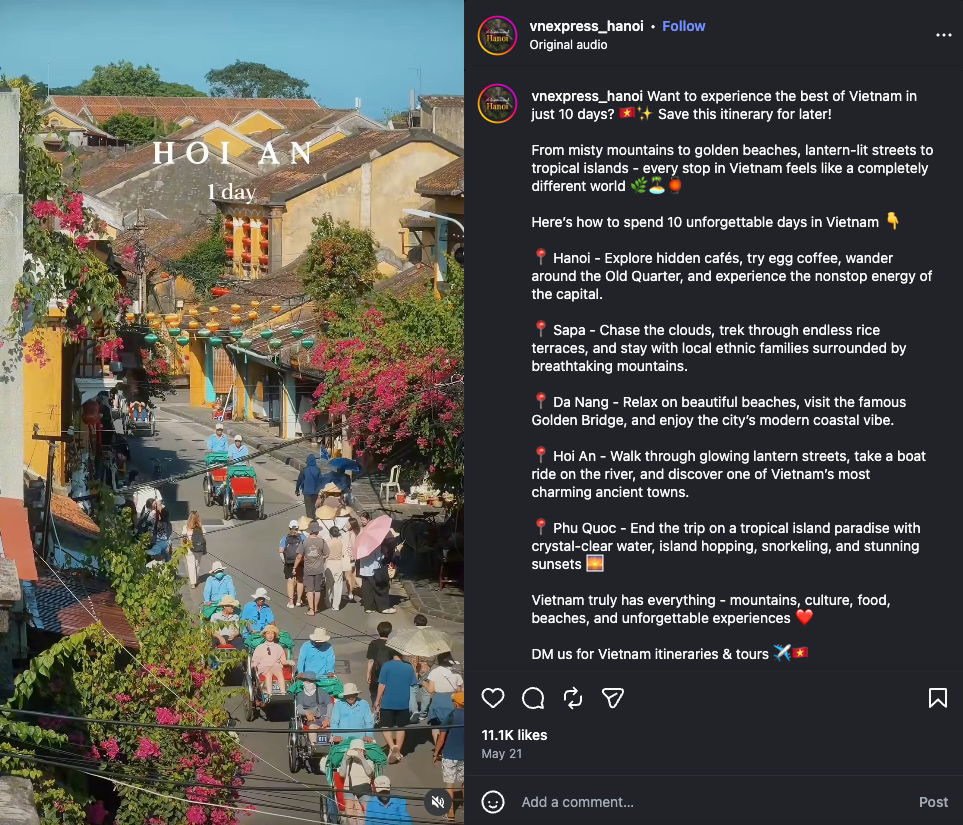
Hoi An is where solo travellers relax. Lantern-lit, small enough to run into the same faces, and surrounded by cycling country. The tailors will make you something in a day.
Ninh Binh gives you the limestone landscapes without the boat crowds of Ha Long, and it's small enough that the hostel becomes your social life immediately.
Ho Chi Minh City is faster, louder and more modern than Hanoi, with the best nightlife and the most demanding traffic in the country.
Pu Luong and the northern mountains are the quiet counterweight. Rural Vietnam consistently reports lower crime than the cities, and the trade-off is that you need transport sorted.
When to Go
Vietnam is 1,650km top to bottom and the weather does not agree with itself along the way. There is no single best month, only a best month for where you're actually standing.
The north, which is Hanoi, Ninh Binh, Ha Giang and Pu Luong, gets properly cold from December to February. Not novelty cold. Bring-a-jacket cold, especially at altitude. Summer swings the other way into heavy heat and humidity. Autumn and spring are the sweet spots.
The centre, so Hoi An, Da Nang and Hue, has its rainy season from roughly September to December, and it comes with real typhoon risk and occasional street flooding. February to May is the reliable window.
The south, meaning Ho Chi Minh City and the Mekong, is dry from December through April and wet from May to November, though wet season there mostly means a dramatic afternoon downpour rather than a washout.
How to Actually Meet People
Vietnam does not leave you alone for long, so be prepared to never truly be alone. However, making connections and meeting people to share the experiences with can be done through a few different way:
- Street food tours are the fastest social hour in the country and you'll eat better than you would have alone.
- Overnight trains and sleeper buses produce entire friendships between two cities.
- Hostel bars in Hanoi, Hoi An and Ho Chi Minh City run organised nights specifically so nobody has to be brave.
- Cooking classes in Hoi An are practically a rite of passage.
- Ha Long and Cat Ba boat trips put twenty strangers on a boat for two days, which resolves itself.
You will end up in a WhatsApp group with six people from four countries by day three. We have never seen it not happen.

Getting Around on Your Own
- Domestic flights are cheap and the country is long. Hanoi to Ho Chi Minh City is a two-hour flight or a very long overnight anything.
- Overnight trains are a genuine experience and a social one. Cabins are shared.
- Sleeper buses are cheaper, less comfortable, and the classic backpacker route.
- Ride-hailing apps work well in cities and remove haggling entirely.
- Motorbikes: the most tempting and the most dangerous choice. Licence, helmet, insurance that actually covers you, or take a driver.
Which is why the group trips run November to April. It's the only stretch where you can cross the whole country without booking yourself into somebody's monsoon.
Which Getaway Works Best Solo
If what appeals about going alone is the independence, and what puts you off is the first week and the logistics of a country where the transport is genuinely complicated, a small-group trip is the middle path. You still arrive on your own. You just don't have to solve the hard parts on your own.
The Getaways range is built around this. Roughly 90% of travellers on these trips are travelling solo, every trip is limited to ages 18 to 35, and they're operated by yours truly!
The details that matter specifically when you're booking alone:
- You won't be in a dorm. Twin-share at selected 3 or 4-star hotels. Book alone and you're matched with another traveller of the same gender. If you'd rather have your own space at the end of the day, a private room upgrade can be added for an extra cost where availability allows. Yeah, we mean bizz-ness when we travel.
- The group exists before you fly. Social access and a WhatsApp group mean the first conversation happens weeks out, not in an airport.
- Someone meets you. Airport meet and transfer, then a Global Guide with the group throughout.
- Insurance is included for the scheduled trip duration through Global Travel Cover, with important limits covered below.
Three Vietnam trips, all running November to April.
Northern Vietnam Untamed. Hanoi's Old Quarter and street food scene, then out to Pu Luong Nature Reserve for hiking between bamboo forests and rice terraces and a home-cooked meal with a local family, cycling around Ninh Binh, and an overnight cruise through Ha Long Bay with kayaking, a cooking class and dinner under the stars. Worth knowing before you book: the north gets genuinely cold from November to March, and the trip notes specifically say to bring a jacket or fleece for the Ha Long cruise and the Pu Luong valleys.
Southern Vietnam Pho Real. Starts in Hoi An with countryside cycling, a bamboo basket boat through the coconut forests and lantern making, then two overnight trains carry you south via Nha Trang's islands and snorkelling to Ho Chi Minh City and the Mekong Delta floating markets. One detail for solo travellers specifically: the overnight trains are shared two-bed cabins, so the same-gender matching applies there too. There are two free days built in, one in Hoi An and one in Nha Trang.
Ultimate Vietnam Without Compromise runs 16 days across the full length of the country, and Ultimate Thailand & Vietnam extends to 29 days across two.
When this is the wrong choice. The trip pages are upfront that they aren't designed for people wanting a highly structured, fast-paced tour, and they aren't luxury. Vietnam is also very manageable independently and considerably cheaper that way. A fixed eight-day route will frustrate anyone whose favourite part of solo travel is deciding on Tuesday to stay somewhere until Friday.
Money and What Catches Solo Travellers
- Cash outside the cities. Cards are fine in Hanoi, Nha Trang and Ho Chi Minh City. The Mekong floating villages, Pu Luong and Ninh Binh largely are not.
- Solo costs more per night. Rooms are priced per room. Twin-share on a group trip is the fix.
- Budget the gaps. Flights, departure airport transfers, visa costs, vaccinations, local tourist taxes, meals not listed and daily spending all sit outside a booked trip.
- Bottled water only, and the trip notes say the same.
- The insurance boundary is the important one. Cover included with a Getaway is a base travel medical policy for the scheduled trip duration. It excludes pre-existing conditions and does not extend to cancellation or to travel outside your trip dates. Arriving early, staying on, or hopping into Cambodia for a week is uncovered time, and medical evacuation from rural Vietnam is expensive. Global Travel Cover, the sister brand in the Global Work & Travel family, exists for those edges. Alone in a country where the main risk is a road accident, this is the least sensible thing to skip.
The Visa Bit, Quickly
Vietnam made this easy and most people still get it wrong by paying too much for it.
The e-visa is open to every nationality, runs up to 90 days, and comes in single or multiple entry. You apply online at evisa.gov.vn, upload a passport scan and a photo, pay by card, and get a PDF back. Standard processing is three to five working days, so give yourself a week and a bit of buffer rather than doing it from the airport taxi.
Two things worth knowing before you start. Search "Vietnam visa" and the first results are usually agency sites charging several times the government fee for the exact same document, so go direct. And you nominate your entry point when you apply, so if you're flying into Hanoi and out of Ho Chi Minh City, that's the one that has to match. Exiting is unrestricted.
If Cambodia or Laos is on the list, take multiple entry. It's the difference between a border run being an afternoon and being an entire administrative saga.

Final Thoughts
There's a moment, usually about four days in, when you step off a kerb into six lanes of motorbikes without thinking about it. You don't hesitate and you don't look back and you get to the other side and realise you've stopped finding it remarkable.
That's the whole trip, in a way. You arrive braced for something difficult and leave having quietly recalibrated what you're capable of handling on your own.
The traffic is still going to be there. So are you now, apparently.

Jessie Chambers
Jessie is a globetrotter and storyteller behind the Global Work & Travel blog, sharing tips, tales, and insights from cities to remote escapes, informed by the collective experience and real-world knowledge of teams across our business.